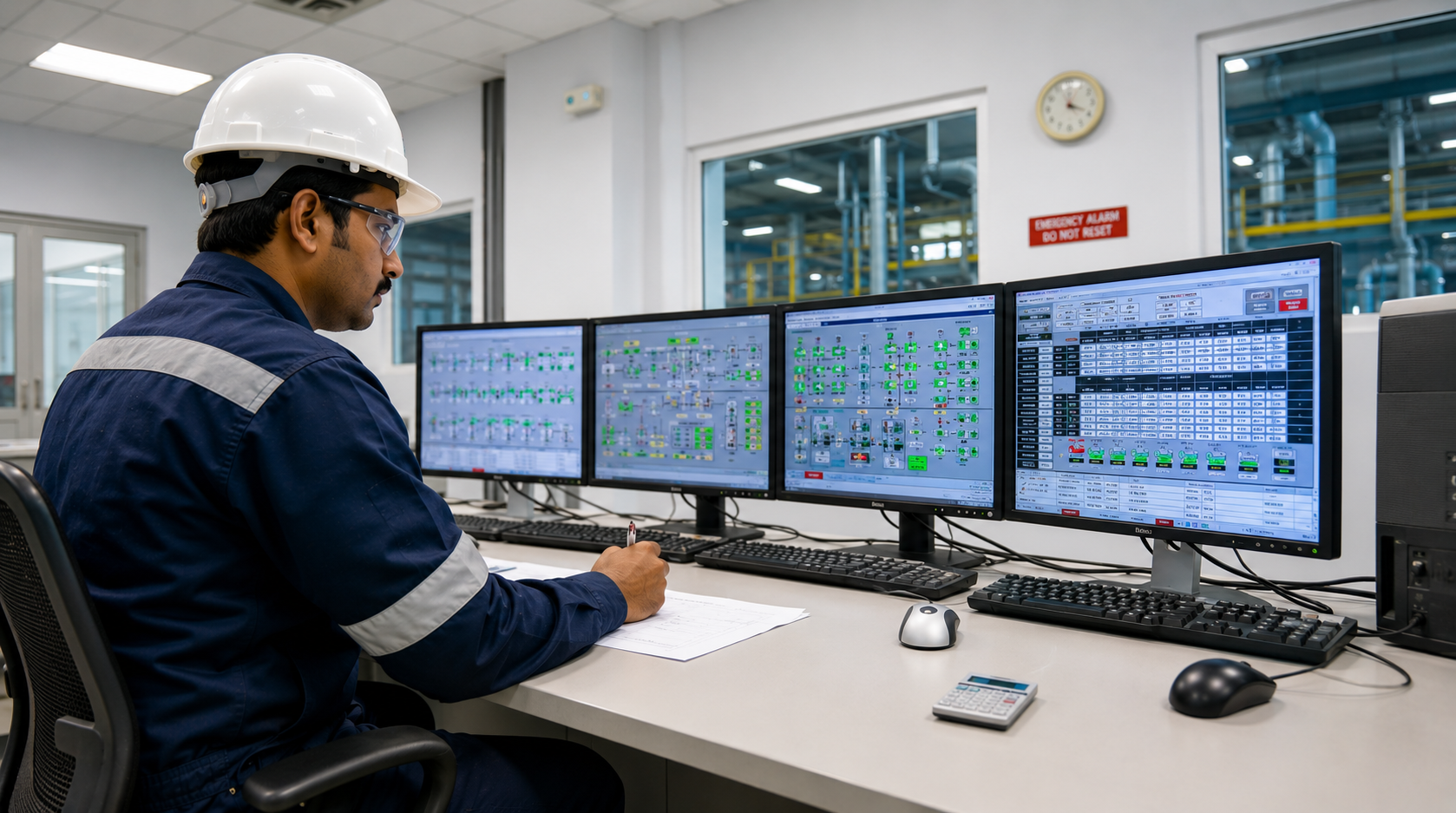
Pulp Mill Automation Guide: When to Deploy PLCs vs. Distributed Control Systems (DCS)
When deciding on a PLC vs DCS pulp mill automation strategy, matching the right control system architecture to the correct process area is critical. In pulp mill automation, the choice between a Programmable Logic Controller (PLC) and a Distributed Control System (DCS) is about matching the right architecture to the right part of the process
In this comprehensive guide, we compare control loop density, database designs, and operational costs across the woodyard, continuous chemical digester, recovery boilers, and bleaching plant.
For instance, a leading Kraft paper mill in India recently lost ₹18 Lakhs in a single shift. A simple wash-press sequence got stuck. The culprit was a communication lag between three standalone PLCs. While the PLC network tried to resolve the handshake, the pulp digester blow-line backed up
The operator stood in front of the local HMI, blind to the pressure spike in the main tower. By the time he realized, the stock had thickened. The pipe clogged, and the entire chemical line had to be flushed manually.
That is six hours of downtime. Plus wasted chemicals and a massive cleanup bill.
Understanding the exact dividing line between Programmable Logic Controllers (PLCs) and Distributed Control Systems (DCS) is key to preventing such costly plant downtime."
If you run a paper mill in India—whether in Muzaffarnagar, Morbi, or Coimbatore—this sounds familiar. You want to upgrade your control panels. A local contractor promises "DCS-level control" using a high-end PLC system at half the cost. It is tempting because your Capex budget is tight.
But look at the operational reality first.
Pulp and paper mills are chemical processing plants with heavy analog interactions. If you make the wrong hardware choice today, your maintenance team pays for it for the next fifteen years. Let us dissect where the line should be drawn.
The Raw Truth About the Two Architectures
Let us strip away the vendor sales pitches and look at what these systems actually do.
What a PLC Actually Is
A PLC is a hardware-centric machine controller. It scans inputs, runs logic in milliseconds, and fires outputs. It is built for binary actions—starting motors, opening valves, or conveyor interlocks.
Yes, modern PLCs handle PID loops. But their engine runs a serial scan loop. Dump 150 interacting loops onto a PLC, and scan time climbs. Control gets sluggish.
Worse, each PLC is a data island. If PLC A needs to talk to PLC B, you write custom communication blocks. That is another point of failure.
What a DCS Actually Is
A DCS is a software-centric process control system. It distributes processing across multiple field controllers.
More importantly, it runs on a single global database. Add a transmitter tag in the digester, and it is instantly visible in the bleach plant. No custom communication blocks or tag mapping.
DCS platforms from Honeywell, ABB, or Valmet were engineered for continuous operations where loop interaction is the default. They use pre-tested function blocks and have built-in redundancy in racks, power and networks.
The Pulp Mill Process Map: Where to Draw the Line
Let us walk through a typical chemical pulping plant, section by section.
1. Wood Yard & Chip Handling
The wood yard is all about mechanical movement. You have logs in Debarkers, chippers shred wood, screens grading, and belt conveyors transferring material to silos.
The control requirements here are straightforward:
-
High-speed motor interlock sequences.
-
Variable frequency drive (VFD) speed regulation.
-
Simple level tracking in chip bins.
There are no complex, interacting analog loops. If the conveyor controller fails, you stop the feed, fix the switch, and start again. The chemical process is not disrupted.
The Verdict: A PLC is the right tool here. It is fast, cheap, and easily managed by any local electrician. Putting a DCS in the wood yard is an waste of budget.
2. Pulp Digesters and Cooking
Now we enter the chemical reactor zone. The digester—especially a continuous one—is a delicate process. You are mixing wood chips with liquor under high pressure and temperature.
To maintain the correct Kappa number, your automation must control the ratio of active alkali to dry wood, temperature profiling across multiple heating zones, the extraction flow rate, and blow-line valve sequences that react to pressure variations.
These variables interact. If liquor temperature drops, the cooking rate slows, changing the required chip retention time.
Programming this on a PLC means writing thousands of lines of custom code. When the developer leaves, troubleshooting becomes a nightmare.
The Verdict: The digester demands a DCS. Its native database structure lets you implement cascade and feedforward loops easily. The built-in alarms also ensure that the operator gets critical warnings before a block occurs.
3. Chemical Recovery Area
The recovery boiler burns concentrated black liquor to recover chemicals and make steam. A recovery boiler cannot tolerate glitches. If a water tube leaks into the molten chemical smelt at the bottom of the furnace, you get a smelt-water explosion. It can destroy the boiler house and shut your mill down for months.
You need:
-
Absolute hardware redundancy (if controller A dies, controller B takes over in microseconds without a single valve changing position).
-
A dedicated safety system (SIS) for burner management.
Complete system visibility with zero data drops.
Redundant PLCs are a gamble. The transition logic is custom-coded; if a bug exists, the standby controller might fail to wake up during a primary switchover.
The Verdict: DCS is mandatory. The risk is too high. The integration between process loops and safety must be native and certified.
4. The Bleach Plant
The bleach plant mixes chemical reactions (chlorine dioxide, oxygen, peroxide) requiring precise pH and temperature control, with mechanical washing filters and pumps.
Here, many mills in India go for a hybrid setup:
-
A DCS manages the chemical dosage and tower levels.
-
A PLC handles the start-stop logic and interlocks for the wash presses and conveyors.
-
Both systems share variables over a high-speed OPC UA network.
The Verdict: A hybrid approach works well here if you have a competent systems integrator. It keeps hardware costs down while keeping chemical control safe.
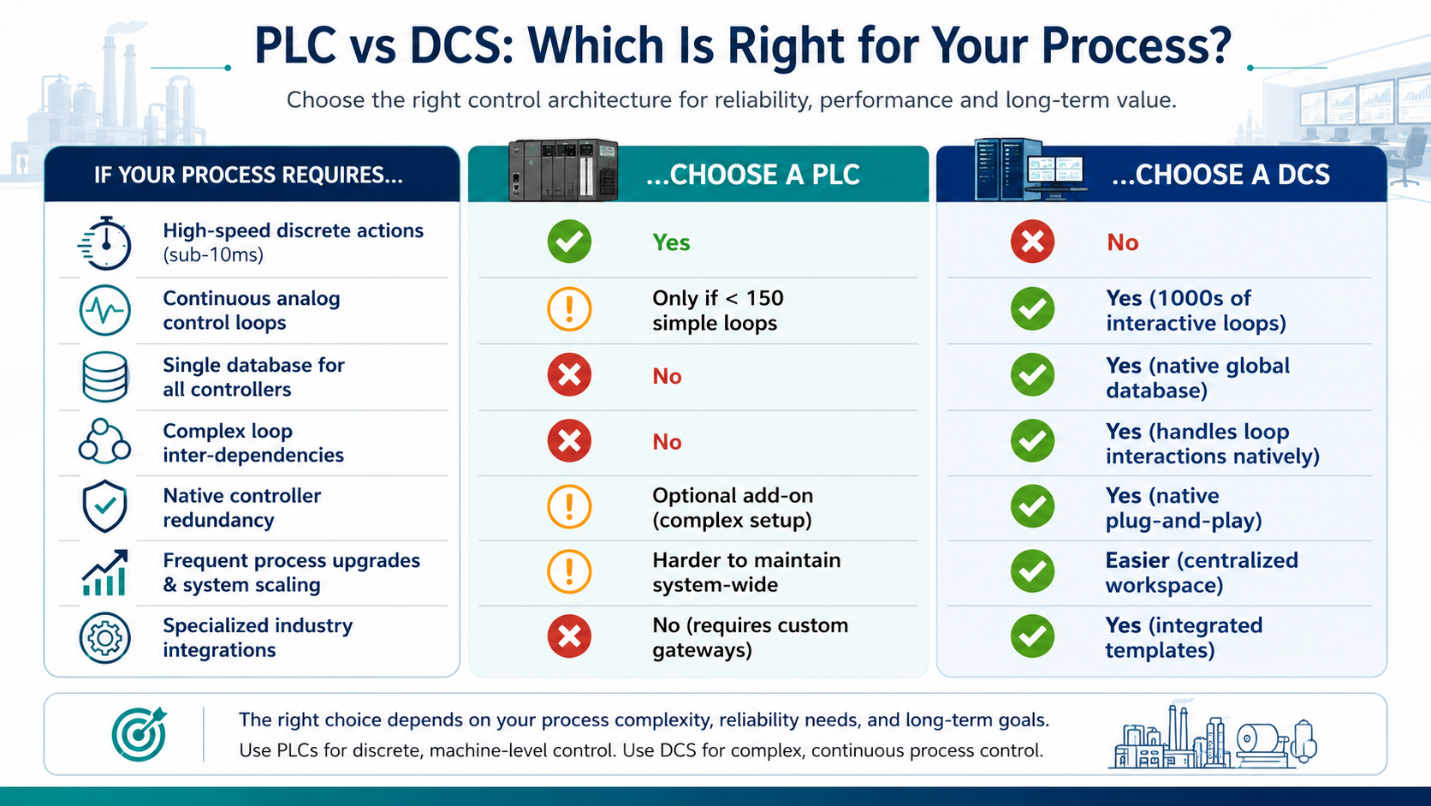
Decision Matrix: When to Use PLC vs. When to Use DCS
To make it simple for engineering teams, here is the decision matrix summarizing when to select each system:
Frequently Asked Questions
Can we run a digester on a PLC?
Yes, but software maintenance is high. Without a global database, you spend hours mapping tags between controllers and HMIs. Any modification requires manual updates across multiple systems, raising the chance of errors.
What are the main DCS brands in Indian paper mills?
Most large-scale mills run on Honeywell, ABB, or Valmet systems. Vizen Solutions works as an engineering and authorized Channel Partner for Honeywell C300 DCS System with 75+ Installation in India & abroad, helping pulp & paper mills customize their control strategies and interface with plant instrumentation.
The Four Questions Your Team Must Answer
Before you issue a purchase order for your next control system, answer these four questions:
How many control loops interact?
If you have over 150 analog loops where a change in one valve affects three other loops, you need a DCS.
If a system crash costs you Lakhs of rupees in lost production, you need the native, hot-standby redundancy of a DCS. If a system crash costs you lakhs of rupees in lost production, you need a DCS with native, hot-standby redundancy and hot-swappable I/O modules. The Honeywell C300 DCS System supports hot-swappable I/Os, allowing faulty I/O modules to be replaced while the system remains online, minimizing downtime and ensuring uninterrupted plant operation.
PLCs require specialized programmers for complex logic. A DCS uses standardized process library blocks that your plant instrument engineers can easily calibrate.
We see too many mills over-spending on DCS systems for simple utilities, and even more mills suffering from chronic downtime because they tried to automate a chemical pulp line with a low-cost PLC network.
The secret to a highly efficient pulp mill is a balanced, hybrid control philosophy. Let your PLCs handle the high-speed machinery in the woodyard and the baling press. Let a DCS handle the digester, chemical recovery, and bleaching towers.
If you are planning an upgrade and want an honest, engineering-first assessment of your mill's control architecture, connect with our engineering team at Vizen Solutions. We will help you design a system that keeps your plant running 24/7 without blowing your budget.
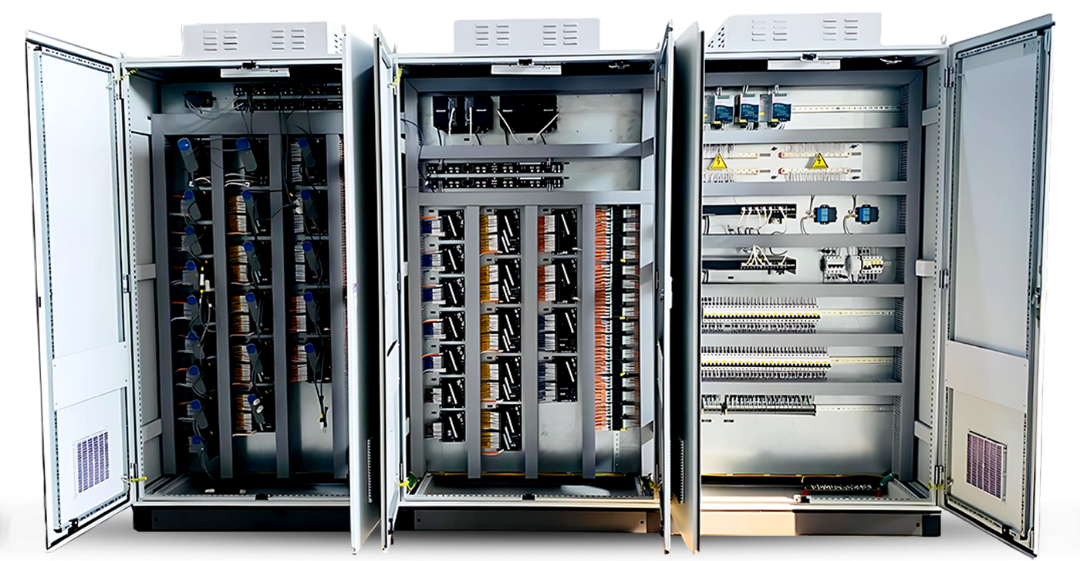
Vizen Solutions is a Honeywell C300 DCS System specialist process automation integrator based in IMT Faridabad. We design, install, and commission PLC, DCS, and electrical control panels for process industries across India.
For More Information, Contact Our Team
Team Details